| Northern Europe, Canada, and Cold Continental Areas |
Fine-grained soils, frost-susceptible silts, seasonal wet zones, and variable subgrades. |
Frost heave, thaw weakening, differential settlement, and loss of bearing capacity during spring thaw. |
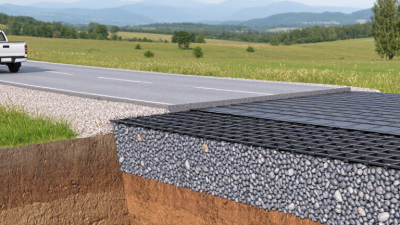
Biaxial geogrid for aggregate-base reinforcement; use a geotextile separator where fine particles may migrate into the aggregate. |
High junction efficiency, resistance to installation damage, adequate aperture size for aggregate interlock, and stable tensile performance at low temperatures. |
Control rutting and limit deformation during thaw periods; design drainage and frost protection separately from reinforcement. |
Confirm freeze-thaw durability, ultraviolet exposure during construction, and compatibility with deicing salts. Prevent water accumulation beneath the reinforced layer. |
Gradation, Atterberg limits, soaked CBR or resilient modulus, frost susceptibility, freeze-thaw durability, and installation-damage testing. |
High |
| Western and Central Europe |
Variable granular and cohesive soils, recycled aggregates, and restricted construction corridors. |
Uneven settlement, construction traffic deformation, and limited working space. |
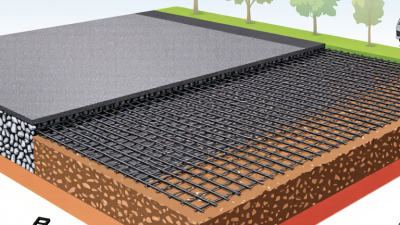
Biaxial or triangular-aperture geogrid for base reinforcement; uniaxial geogrid for reinforced slopes or walls. |
High tensile stiffness at low strain, reliable junction strength, and compatibility with the specified aggregate or fill. |
Reduce base-course thickness only when supported by project-specific structural calculations and performance data. |
Assess exposure to wet-dry cycles, hydrocarbons, alkaline materials, and temporary UV exposure during storage and installation. |
Plate-load or deflection testing, CBR or modulus testing, aggregate compatibility, junction strength, and construction trial sections. |
Medium |
| Mediterranean and Semi-Arid Regions |
Well-graded granular soils, calcareous soils, collapsible soils, and occasional weak silty layers. |
Surface erosion, shrinkage and collapse after wetting, settlement, and construction damage from angular aggregate. |
Biaxial geogrid for pavement bases; uniaxial geogrid for slopes and reinforced soil structures; use erosion-control measures where needed. |
High abrasion and puncture resistance, strong junctions, and dimensional stability under high temperatures. |
Improve load distribution and manage deformation; do not use geogrid as a substitute for controlling collapsible soil or erosion. |
Check elevated installation temperatures, UV exposure, dust contamination, and rare but intense rainfall events. |
Collapse potential, shear strength, particle angularity, abrasion resistance, tensile retention after thermal exposure, and drainage assessment. |
High |
| Desert and Arid Regions |
Loose sands, poorly graded granular soils, saline soils, and windblown or contaminated fill. |
Low confinement, aggregate migration, wind erosion, rutting, and settlement under repeated traffic. |
Biaxial geogrid with aperture geometry suited to the base aggregate; uniaxial geogrid for reinforced embankments. |
Strong aggregate interlock, resistance to installation damage, low creep under sustained load, and high dimensional stability. |
Improve lateral restraint and reduce aggregate spreading; provide adequate compaction and edge confinement. |
Protect rolls from prolonged sunlight before installation. Evaluate saline or alkaline groundwater and thermal cycling. |
Particle-size distribution, relative density, direct shear, pullout resistance, installation-damage testing, and chemical compatibility. |
High |
| Tropical and Equatorial Regions |
Highly weathered residual soils, lateritic soils, saturated clays, and organic surface layers. |
High moisture content, rapid loss of strength, pumping, rutting, and biological or chemical degradation of unsuitable materials. |
Biaxial geogrid combined with separation and drainage layers; uniaxial geogrid for reinforced slopes and embankments. |
High tensile stiffness, resistance to hydrolysis and chemical exposure, robust junctions, and low installation-damage sensitivity. |
Maintain drainage and prevent contamination of aggregate; remove or improve highly organic soils before reinforcement. |
Account for high humidity, intense UV exposure, acidic or lateritic soils, and long-term water contact. |
Moisture-density relationship, soaked CBR, undrained shear strength, organic content, chemical compatibility, and hydraulic testing. |
High |
| Monsoon and High-Rainfall Areas |
Soft alluvial clay, silty subgrades, floodplain deposits, and seasonally saturated fill. |
Pore-pressure buildup, pumping, erosion, rapid saturation, and reduced subgrade strength during heavy rainfall. |
Biaxial geogrid with a properly designed separator and drainage system; use uniaxial geogrid for embankment reinforcement. |
High junction strength, resistance to hydrolysis, stable tensile properties when wet, and compatibility with drainage aggregates. |
Improve construction-stage stability and reduce aggregate intrusion into soft subgrade; design for consolidation and settlement independently. |
Design for frequent wetting, flooding, sediment accumulation, and possible debris impact. Provide positive drainage and outlet protection. |
Hydraulic conductivity, undrained shear strength, consolidation, cyclic loading, pullout in saturated soil, and scour assessment. |
High |
| Coastal and Marine-Influenced Sites |
Loose sand, marine clay, reclaimed fill, saline groundwater, and variable fill thickness. |
Settlement, lateral spreading, scour, tidal saturation, and chemical exposure from salts. |
Biaxial geogrid for aggregate platforms; uniaxial geogrid for reinforced embankments or retaining structures; use geosynthetics specified for separation or filtration where required. |
Low creep, high junction efficiency, chemical resistance, and reliable performance under sustained tensile loading. |
Address settlement, liquefaction potential, scour, and groundwater conditions before selecting reinforcement strength. |
Assess saline or chloride-rich exposure, tidal water levels, UV exposure, and possible abrasion from transported sediment. |
Consolidation, liquefaction screening, salinity and pH, pullout, long-term creep, scour, and cyclic loading tests. |
High |
| Mountainous and High-Altitude Areas |
Colluvium, fractured rock, residual soils, steep slopes, and thin or variable cover soils. |
Slope instability, rockfall, erosion, drainage concentration, and localized tensile loading. |
Uniaxial geogrid for reinforced slopes and walls; biaxial geogrid for access roads and working platforms. |
High longitudinal tensile capacity, low creep, strong connection or facing compatibility, and resistance to installation damage from coarse fill. |
Check global, internal, and compound stability; provide benches, filters, toe protection, and controlled drainage. |
Consider freeze-thaw cycles, snowmelt, UV exposure, steep-access installation, and potential exposure to sharp rock fragments. |
Shear strength, pullout, connection strength, rock-size distribution, rainfall or snowmelt runoff, and slope-stability analysis. |
High |
| Seismic Regions |
Loose saturated sand, liquefiable deposits, soft alluvium, and variable engineered fill. |
Dynamic settlement, lateral spreading, loss of confinement, and cyclic deformation. |
Biaxial geogrid for reinforced bases and platforms; uniaxial geogrid for reinforced soil structures designed for seismic loading. |
High tensile stiffness, ductility, low creep, reliable junctions, and documented cyclic or dynamic performance where required. |
Use geogrid as one part of a seismic design; evaluate liquefaction, foundation response, drainage, and structural connections. |
Check long-term durability and performance under cyclic loading, groundwater fluctuation, and post-event repair conditions. |
Cyclic triaxial or simple-shear testing, liquefaction assessment, dynamic interface friction, pullout, and connection testing. |
High |
| Urban Road Reconstruction |
Existing pavement, utility backfill, mixed fill, weak spots, and restricted excavation depth. |
Reflective deformation, differential settlement, utility-related movement, and limited access for compaction. |
Biaxial geogrid for base reinforcement; select a separator or filtration geotextile when soil fines can contaminate the aggregate. |
High stiffness at low strain, compact roll configuration, strong junctions, and tolerance to repeated construction handling. |
Coordinate with utility protection, drainage, compaction equipment, and staged traffic loading. |
Assess exposure to fuel, oils, deicing chemicals, and long storage periods in sunlight. |
In-situ density, deflection testing, subgrade modulus, aggregate contamination, installation-damage testing, and trial compaction. |
Medium |
| Landfill Caps, Waste Facilities, and Containment Areas |
Compressible waste, low-permeability covers, drainage layers, and chemically variable fill. |
Differential settlement, puncture of adjacent geosynthetics, interface sliding, and chemical exposure. |
Select geogrid only where tensile reinforcement is required; use it with compatible barrier, drainage, and protection layers. |
High chemical resistance, low creep, controlled interface friction, and low risk of puncturing adjacent geomembranes or geotextiles. |
Design for differential settlement and interface stability; avoid assuming that geogrid replaces a liner, barrier, or drainage layer. |
Evaluate leachate chemistry, temperature, long-term loading, UV exposure during construction, and compatibility with adjacent materials. |
Chemical immersion, tensile retention, creep, interface shear, puncture, compression, and differential-settlement testing. |
High |
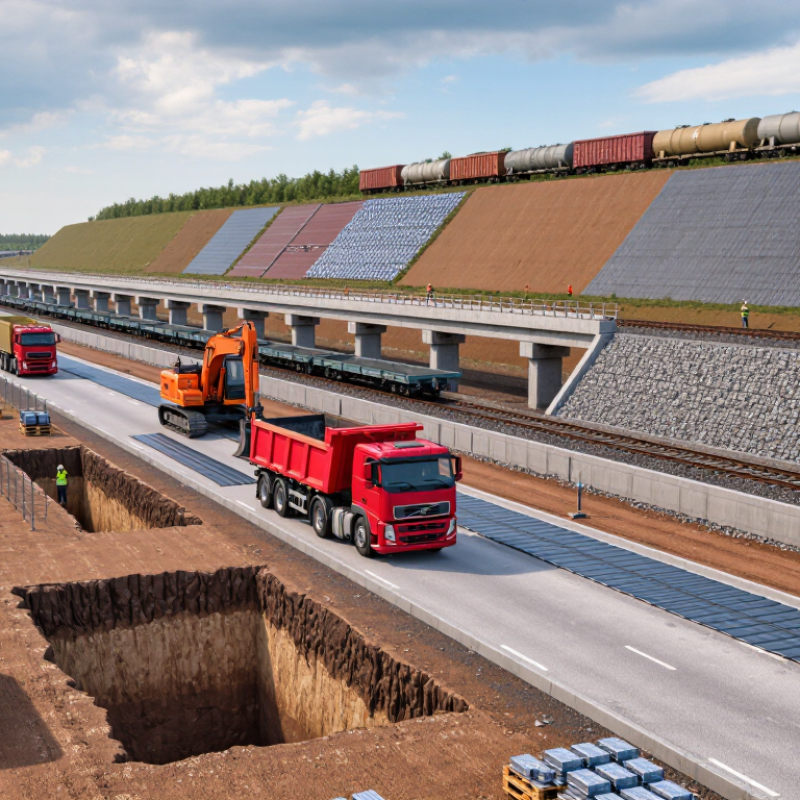
| Railway and Heavy-Load Platforms |
Ballast, sub-ballast, granular formation, soft subgrade, and repeated high-cycle loading. |
Ballast fouling, lateral spreading, differential settlement, and progressive rutting or pumping. |
Biaxial or multi-axial geogrid selected for aggregate confinement; use separation and filtration layers where fines migration is possible. |
High tensile stiffness, strong junctions, fatigue resistance, resistance to installation damage, and stable performance under repeated loading. |
Control permanent deformation and maintain drainage; use cyclic performance data relevant to the loading regime. |
Consider freeze-thaw, water table fluctuations, construction abrasion, and exposure to maintenance chemicals. |
Repeated-load testing, ballast or aggregate degradation, resilient modulus, filtration, junction strength, and installation-damage testing. |
High |
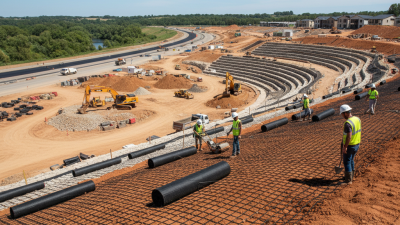
| Temporary Access Roads and Construction Platforms |
Soft clay, peat margins, wet topsoil, uncontrolled fill, and rapidly changing moisture conditions. |
Vehicle rutting, aggregate punching into subgrade, loss of access, and difficult removal or recovery. |
Biaxial geogrid with separation where necessary; use a robust, easily handled product with sufficient aperture-aggregate compatibility. |
High installation-damage resistance, adequate tensile stiffness, easy deployment, and sufficient junction strength for construction traffic. |
Focus on construction-stage bearing capacity, drainage, aggregate thickness, and safe trafficking rather than permanent pavement design alone. |
Plan for rainfall, standing water, mud contamination, UV exposure during temporary storage, and reuse requirements. |
Field plate-load testing, rut-depth monitoring, CBR or vane shear, installation-damage assessment, and trial placement. |
Medium |
| Reinforced Soil Walls and Steep Slopes |
Engineered granular backfill, residual soil, select cohesive fill, or variable imported materials. |
Internal sliding, pullout, connection failure, excessive deformation, and global slope instability. |
Uniaxial geogrid with reinforcement aligned in the primary load direction; use facing-compatible connection details. |
Long-term design strength, low creep, adequate pullout resistance, connection strength, and durability appropriate to the design life. |
Check internal, external, compound, and global stability; account for surcharge, groundwater, seismic forces, and construction sequence. |
Provide drainage behind the facing and prevent water pressure buildup. Assess chemical and biological durability for the specified design life. |
Pullout, direct shear, connection strength, creep, durability retention, backfill compaction, and full stability analysis. |
High |
| Airport Aprons and Heavy-Duty Pavements |
Compacted granular base, weak subgrade zones, frost-sensitive soil, or variable reclaimed ground. |
Repeated-load rutting, differential settlement, pumping, and loss of surface tolerance. |
Biaxial geogrid for base reinforcement, selected through trafficking and pavement-response analysis. |
High stiffness at low strain, strong junctions, resistance to construction damage, and documented performance under repeated loading. |
Coordinate geogrid selection with pavement thickness, aircraft loading, drainage, and strict surface-level tolerances. |
Consider fuel and hydraulic-fluid exposure, freeze-thaw, deicing chemicals, and high-temperature surface conditions. |
Resilient modulus, repeated-load testing, aggregate degradation, fuel or chemical compatibility, and field deflection monitoring. |
High |